Complete RV, Camper and Trailer Removal
Old campers, RVs, and trailers can be difficult to remove once they stop being roadworthy. Tires may be flat, frames may be rusted, roofs may be leaking, and years of sitting can leave the unit filled with damaged furniture, appliances, household items, and debris.
Rapid Junk Removal RI provides full-service RV, camper, and trailer removal throughout Rhode Island and Southern Massachusetts. We remove unwanted units from residential properties, commercial yards, storage facilities, campgrounds, farms, marinas, repair shops, and other accessible locations.
Whether the unit can still be towed normally or requires additional preparation, specialized transportation, or on-site dismantling, our experienced local team will review the condition and determine the most practical removal plan.
Our service can include the unit, its contents, loose parts, surrounding debris, and other approved items left at the property. From the initial quote through loading, hauling, cleanup, and final disposal, we handle the complete project.
What’s Included With Our Removal Service?
Removing an unwanted camper or trailer usually involves more than connecting it to a truck. The condition of the frame, tires, axles, hitch, landing gear, body, and surrounding access can all affect how the unit must be moved.
Our RV, camper, and trailer removal service may include:
- Review of the unit and surrounding property
- Removal of units with or without usable tires
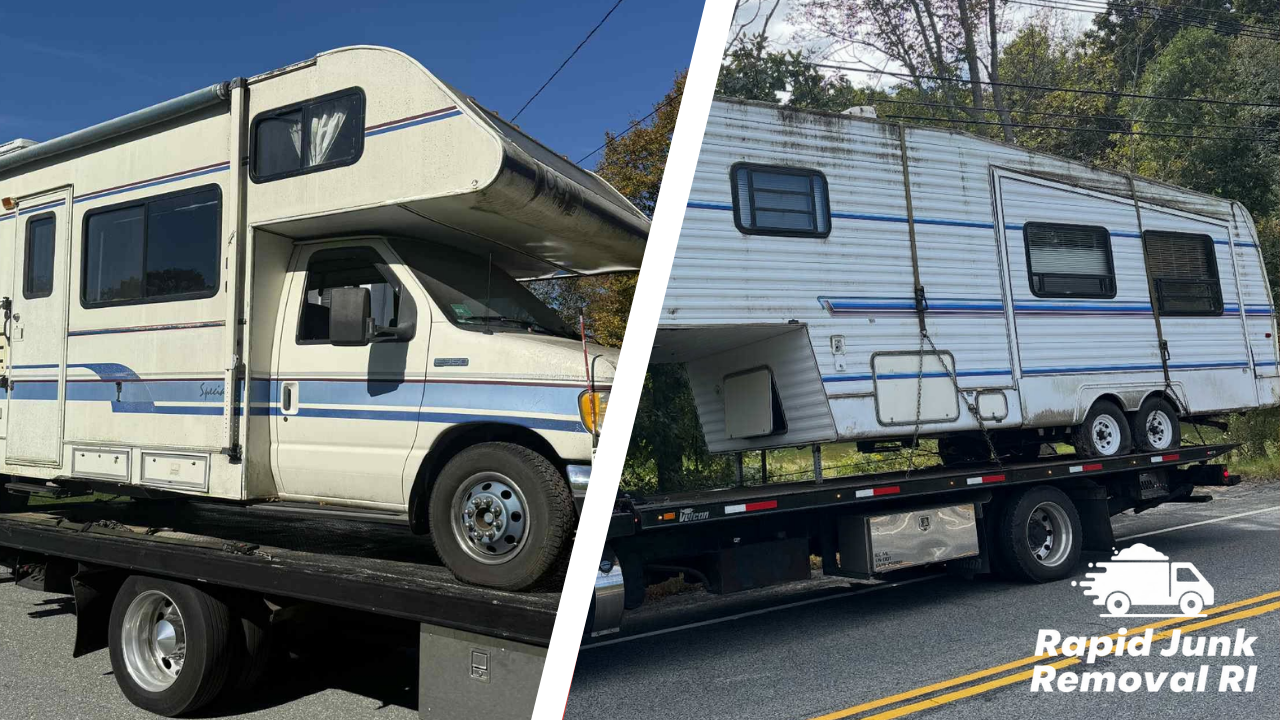
- Towing, loading, or flatbed transportation when appropriate
- On-site dismantling when normal removal is not practical
- Removal of loose contents and interior debris
- Removal of detached parts, awnings, steps, and accessories
- Removal from yards, driveways, storage areas, and commercial properties
- Use of trucks, flatbeds, trailers, dumpsters, or equipment when needed
- Basic cleanup of the immediate removal area
- Complete hauling and disposal
You do not need to determine how the unit will be moved before contacting us. Send current pictures, the approximate size, the location, and information about the condition. We will review the project and explain what is needed.
RVs and Campers We Remove
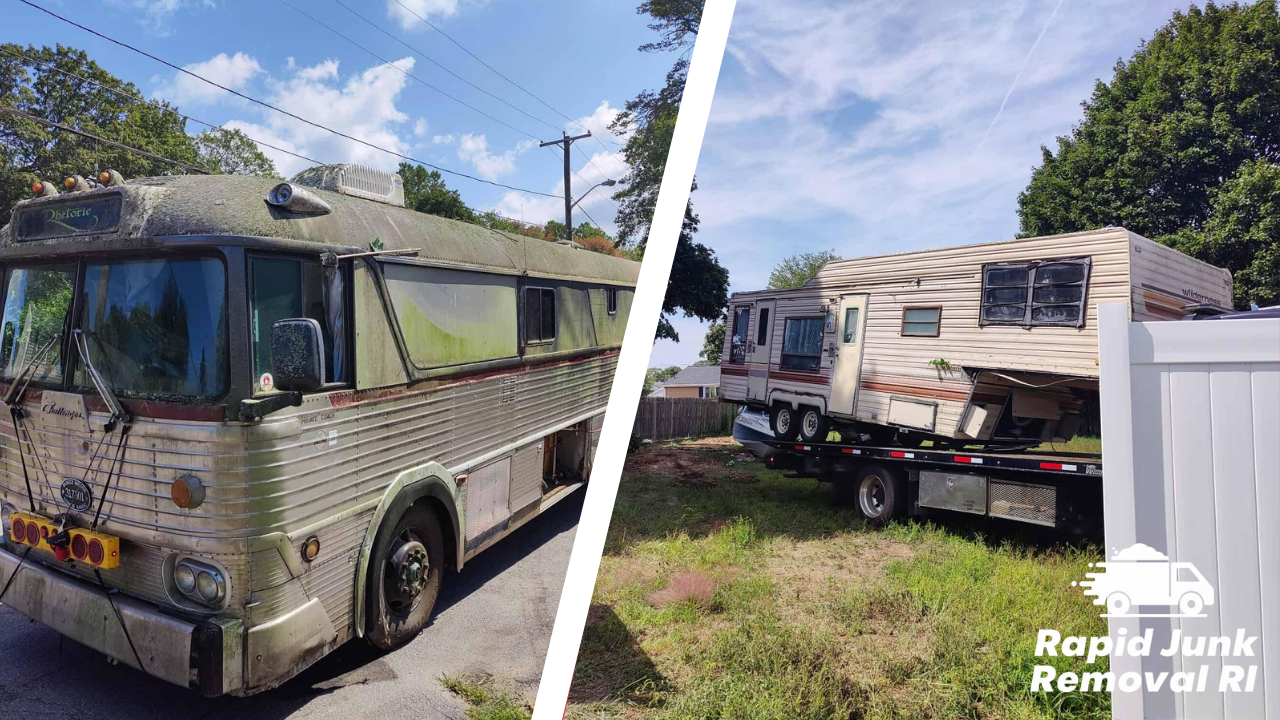
Our team can evaluate recreational vehicles and campers of nearly any size, age, or condition. The unit does not need to be clean, repaired, registered, or ready for normal highway towing to be considered for removal.
Travel Trailers
We remove conventional travel trailers ranging from small lightweight campers to larger multi-axle units. These trailers may be intact, damaged, partially stripped, filled with belongings, or no longer safe to tow on their existing wheels.
Send pictures of the complete trailer, hitch, tires, axles, frame, stabilizer jacks, and surrounding access. These details help us determine whether the trailer can be moved normally or needs another transportation method.
Pop-Up Campers
Pop-up and folding campers are smaller than most travel trailers, but older models may have rotted floors, damaged canvas, frozen wheels, broken lift systems, or deteriorated frames.
We can remove the camper along with mattresses, cushions, appliances, awnings, and other approved contents or accessories.
Fifth-Wheel Campers
Fifth-wheel campers require a compatible towing arrangement and sufficient room for equipment to access the front of the unit. Larger fifth wheels may also be extremely heavy, especially when they still contain furniture, appliances, tanks, and stored belongings.
Current pictures and approximate length are important when requesting a quote. Let us know whether the landing gear works and whether the unit is currently supported by blocks, jacks, or another structure.
Motorhomes and RVs
We can evaluate unwanted motorhomes, recreational vehicles, conversion vehicles, and other self-contained camping units. The removal plan depends on the unit’s size, weight, condition, mobility, access, and ownership documentation.
Tell us whether the vehicle runs, whether the tires hold air, whether the steering and brakes function, and whether it is located on pavement, gravel, grass, or soft ground.
Truck Campers
Slide-in and truck-bed campers can be removed from properties, storage areas, trailers, stands, or supporting structures. Loading arrangements depend on whether the camper is still mounted to a vehicle and whether its support jacks are operational.
Project and Abandoned Campers
Many campers begin as restoration projects and remain unfinished for years. Others are left behind by former tenants, property owners, customers, or storage-unit renters.
We remove incomplete, damaged, stripped, rotted, storm-damaged, and abandoned campers once ownership and authorization have been confirmed.
Trailer Removal Services
Our trailer removal service is not limited to recreational vehicles. We also remove many types of unwanted utility, commercial, equipment, and specialty trailers.
Utility Trailers
We remove open utility trailers, landscape trailers, small equipment trailers, homemade trailers, and damaged flatbed trailers.
Trailers with bent frames, missing wheels, frozen hubs, damaged axles, or unusable hitches should be photographed carefully so we can plan the removal.
Enclosed Trailers
Enclosed cargo trailers may contain shelving, tools, equipment, business inventory, construction materials, furniture, or general debris.
We can remove the complete trailer along with approved contents. Anything being kept should be removed before the scheduled service.
Boat Trailers
Old boat trailers can remain on a property long after the boat has been sold or removed. We remove empty boat trailers, damaged marine trailers, and trailers that are no longer roadworthy.
If a boat is still sitting on the trailer, the project should be evaluated as a complete boat removal. Send pictures of both the boat and trailer so we can review the correct equipment requirements.
Equipment and Machinery Trailers
We can evaluate equipment trailers, construction trailers, commercial flatbeds, and other heavy-duty units. Provide approximate dimensions, axle count, current condition, and any known weight information.
Trailer Frames and Partially Dismantled Units
Some trailers are little more than a frame, axle assembly, and pile of parts. Others have been partially dismantled and left with sharp metal, damaged decking, or unstable components.
We can remove approved trailer frames, axles, wheels, hitches, decking, panels, and related debris as part of the project.
Units That Cannot Be Towed Normally
A camper or trailer does not need to be roadworthy for us to consider the removal. Many of the units we evaluate have been sitting for years and cannot simply be connected to a pickup truck.
Common problems include:
- Flat, missing, or dry-rotted tires
- Frozen wheel bearings
- Collapsed suspension
- Damaged or rusted frames
- Broken hitches or couplers
- Missing wheels or axles
- Failed landing gear or stabilizers
- Rotted floors and walls
- Storm, fire, or water damage
- Units sunk into soil or surrounded by vegetation
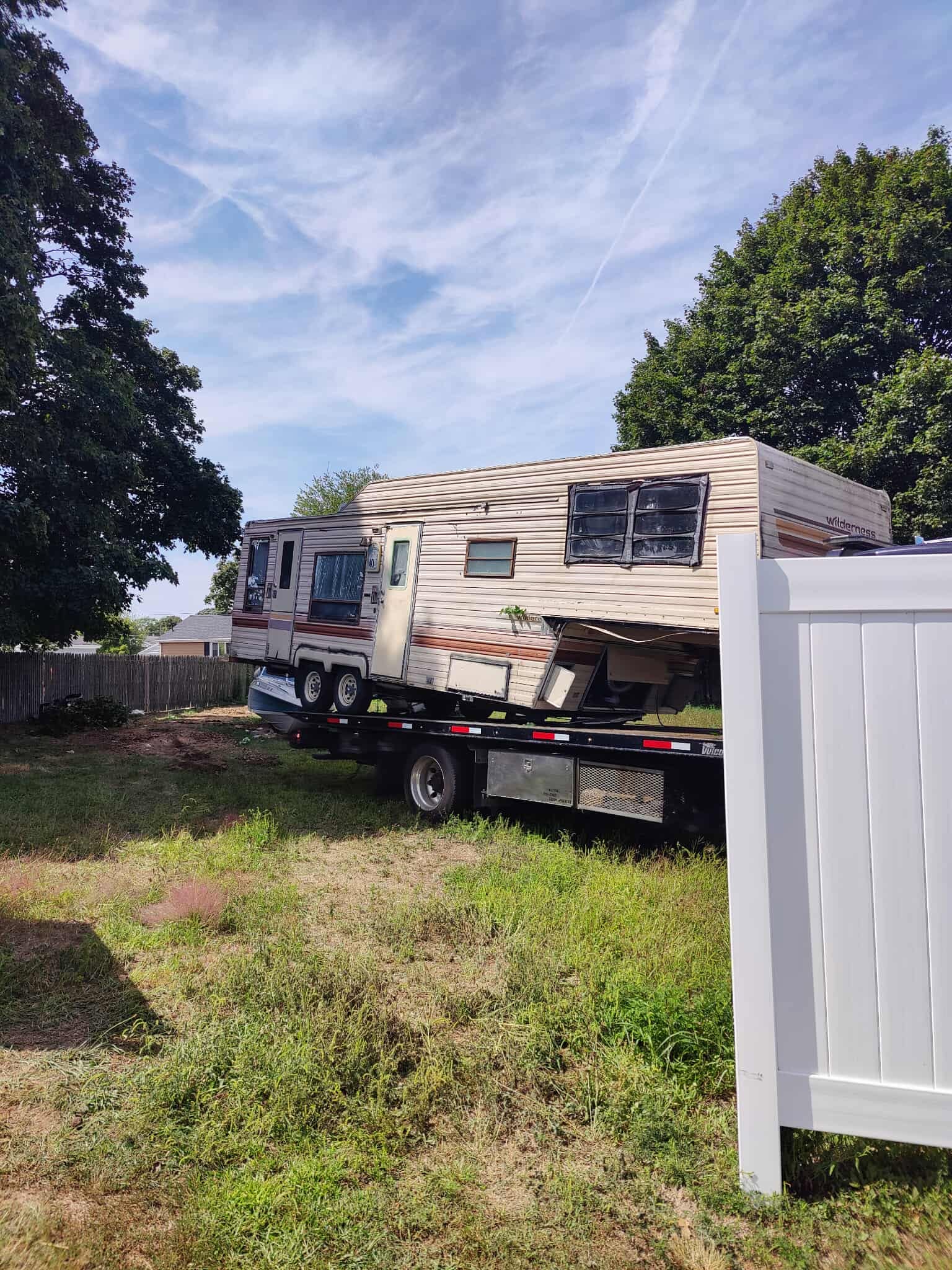
Depending on the project, we may use a flatbed, transport trailer, towing equipment, winching, heavy equipment, or on-site dismantling to complete the removal.
Do not attempt to tow a deteriorated trailer on public roads without first confirming that it is safe and legally prepared for transportation.
On-Site Camper and Trailer Dismantling
Some units are too damaged, blocked in, or deteriorated to be transported intact. In those situations, dismantling the camper or trailer on the property may be the most practical option.
On-site dismantling may be considered when:
- The unit cannot fit through the available access
- The frame is no longer structurally sound
- The camper is missing wheels or axles
- The unit has collapsed or partially fallen apart
- Trees, fences, buildings, or other obstacles prevent normal removal
- The trailer has been permanently positioned for many years
- Ordinary towing would create a safety risk
Our crew can dismantle approved portions of the unit, separate the material into manageable sections, load the debris, and clear the immediate work area.
Dismantling requirements vary considerably. Larger units, restricted access, unstable construction, and extensive contents may require additional equipment or more than one service day.
Removing the Contents Inside
Campers, RVs, and enclosed trailers are often used as long-term storage spaces. Before removal, they may contain furniture, mattresses, appliances, tools, household items, construction supplies, camping gear, and general debris.
Our service can include approved contents such as:
- Mattresses and cushions
- Tables, benches, and interior furniture
- Refrigerators and small appliances
- Televisions and electronics
- Clothing and household belongings
- Tools and equipment
- Boxes and storage containers
- Camping and outdoor equipment
- Loose parts and damaged interior materials
- General non-hazardous debris
Remove anything you plan to keep before the appointment whenever it is safe to do so. If the structure appears unstable, has severe water damage, or contains unknown materials, send pictures and wait for our team to review the condition before entering.
Residential and Commercial Removal
Rapid Junk Removal RI provides RV, camper, and trailer removal for residential and commercial customers.
We work with:
- Homeowners and tenants
- Landlords and property managers
- Campgrounds and seasonal properties
- Storage facilities
- Marinas and boatyards
- Repair shops and towing companies
- Commercial property owners
- Realtors and real estate investors
- Estate representatives
- Contractors and municipalities
Commercial properties may need one abandoned unit removed or several trailers cleared from a yard, storage area, or vacant property. We can coordinate multiple crews, transportation equipment, dumpsters, and heavy equipment based on the project.
Our RV, Camper and Trailer Removal Process
Send Us Current Pictures
Call or text 401-360-5837 or complete our online quote form. For the fastest review, send:
- Pictures of every side of the unit
- The approximate length and type
- Pictures of the hitch or front connection
- Pictures of the wheels, tires, and axles
- The complete removal location
- Pictures showing access to the road
- A description of the current condition
- Information about any contents still inside
We Review the Unit and Access
We evaluate the unit’s size, weight, condition, mobility, frame, wheels, hitch, contents, surrounding access, transportation requirements, and the complete scope of work.
Many projects can be reviewed from clear pictures. Larger motorhomes, fifth wheels, collapsed units, and difficult-access removals may require additional information or an on-site walkthrough.
Confirm Ownership and Authorization
The customer must be legally authorized to remove and dispose of the camper, RV, or trailer. Available titles, registrations, bills of sale, abandoned-property documentation, or other ownership records should be discussed before scheduling.
Requirements can vary based on the type of unit and circumstances. We will explain what information is needed after reviewing the project.
Receive Clear, Upfront Pricing
Pricing is based on the unit’s size, condition, contents, location, access, labor, transportation method, equipment needs, and disposal requirements.
Anything being removed with the unit—including loose parts, surrounding debris, contents, blocks, stands, or accessories—should be shown or described when requesting the quote.
We Complete the Removal
Once the quote is approved, we schedule the appropriate crew and equipment. Our team prepares the unit, loads, tows, transports, or dismantles it as required, removes the approved related materials, and performs a basic cleanup of the immediate work area.
Preparing the Unit for Removal
Most customers do not need to repair, dismantle, or move the unit before our crew arrives. A few basic preparation steps can help avoid delays.
Please:
- Remove personal belongings and anything you plan to keep
- Provide available keys and ownership information
- Tell us about fuel, propane, batteries, oil, or onboard liquids
- Identify holding tanks and their current condition
- Unlock gates and arrange property access
- Move vehicles and other obstacles from the work area
- Notify the campground, facility, or property manager when required
- Tell us if the unit is connected to electricity, plumbing, sewer, or utilities
The camper or trailer should be disconnected from permanent electrical, plumbing, sewer, gas, or utility connections before removal. Professionally installed decks, enclosures, roofs, additions, or utility systems may require separate work and pricing.
Why Choose Rapid Junk Removal RI?
Removing an RV or camper requires more than an ordinary junk truck. The unit may need towing, lifting, winching, flatbed transport, dismantling, or specialized equipment depending on its condition and location.
Customers and property professionals choose Rapid Junk Removal RI because we offer:
- A locally owned Rhode Island company
- Fully insured crews and vehicles
- Removal of campers, RVs, and trailers of nearly any size
- Removal of units with or without usable tires
- Towing, flatbed, and specialized transportation options
- On-site dismantling when appropriate
- Residential and commercial service
- Removal of contents and surrounding debris
- Experience with difficult access and deteriorated units
- Clear, upfront pricing
- Complete removal, hauling, cleanup, and disposal
- More than 175 five-star online reviews
- Thousands of completed local projects
Our goal is to give you one dependable company to coordinate the entire removal instead of leaving you to arrange separate towing, demolition, hauling, and disposal services.
RV, Camper and Trailer Removal Throughout Rhode Island
Rapid Junk Removal RI provides RV, camper, motorhome, and trailer removal throughout Rhode Island and nearby areas of Southern Massachusetts.
Our crews regularly serve Providence, Pawtucket, Cranston, Warwick, East Providence, Johnston, North Providence, Lincoln, Cumberland, Smithfield, Woonsocket, Coventry, West Warwick, North Kingstown, South Kingstown, Newport, Bristol, Warren, Portsmouth, Westerly, Attleboro, North Attleboro, Seekonk, Rehoboth, Taunton, Dighton, Lakeville, and surrounding communities.
Because the equipment needed varies by project, service availability depends on the unit’s size, location, condition, access, and transportation requirements.
Frequently Asked Questions
What types of campers and trailers do you remove?
We remove travel trailers, pop-up campers, fifth wheels, motorhomes, truck campers, utility trailers, enclosed trailers, boat trailers, equipment trailers, and other approved units.
Can you remove a camper that does not have working tires?
Yes. We regularly evaluate units with flat, damaged, dry-rotted, or missing tires. The removal may require loading, flatbed transportation, wheel replacement, or another method.
Can you remove an RV that does not run?
Yes. Non-running RVs and motorhomes can be evaluated based on their size, condition, steering, brakes, tires, access, and available transportation options.
Can you dismantle a camper on the property?
Yes, when transporting the unit intact is not practical. On-site dismantling depends on access, construction, condition, nearby structures, and the amount of material involved.
Can you remove the belongings inside?
Yes. Furniture, mattresses, appliances, household belongings, camping gear, tools, and other approved contents can be included in the project.
Can you remove an abandoned camper?
Yes, after the customer or property representative confirms legal ownership and authorization to remove and dispose of the unit.
Do I need the title?
Documentation requirements depend on the unit and circumstances. Provide any available title, registration, bill of sale, or abandoned-property documentation when requesting your quote.
Can you remove a camper from a backyard?
Yes. Send pictures showing the camper and the complete route to the road. Fences, trees, buildings, slopes, soft ground, and narrow access may affect the removal plan.
Do you remove utility and enclosed trailers?
Yes. We remove many types of open, enclosed, landscape, equipment, and commercial trailers.
How much does RV or camper removal cost?
Pricing depends on the unit’s size, type, condition, location, access, mobility, contents, labor, equipment requirements, transportation, and disposal costs.
Can you remove multiple campers or trailers?
Yes. We can coordinate removal of multiple units from residential properties, storage facilities, commercial yards, campgrounds, and other approved locations.
Are you fully insured?
Yes. Rapid Junk Removal RI is a locally owned and fully insured junk removal company serving Rhode Island and Southern Massachusetts.
Request an RV, Camper or Trailer Removal Quote
Whether you have an old pop-up camper, a damaged travel trailer, a non-running RV, or an abandoned utility trailer, Rapid Junk Removal RI is ready to review the project.
Send us current pictures of the complete unit, wheels, hitch, surrounding access, and anything remaining inside. We will determine the labor, equipment, and transportation needed for the removal.
Call or text 401-360-5837 with the location, approximate size, current pictures, and condition for a free RV, camper, or trailer removal quote.